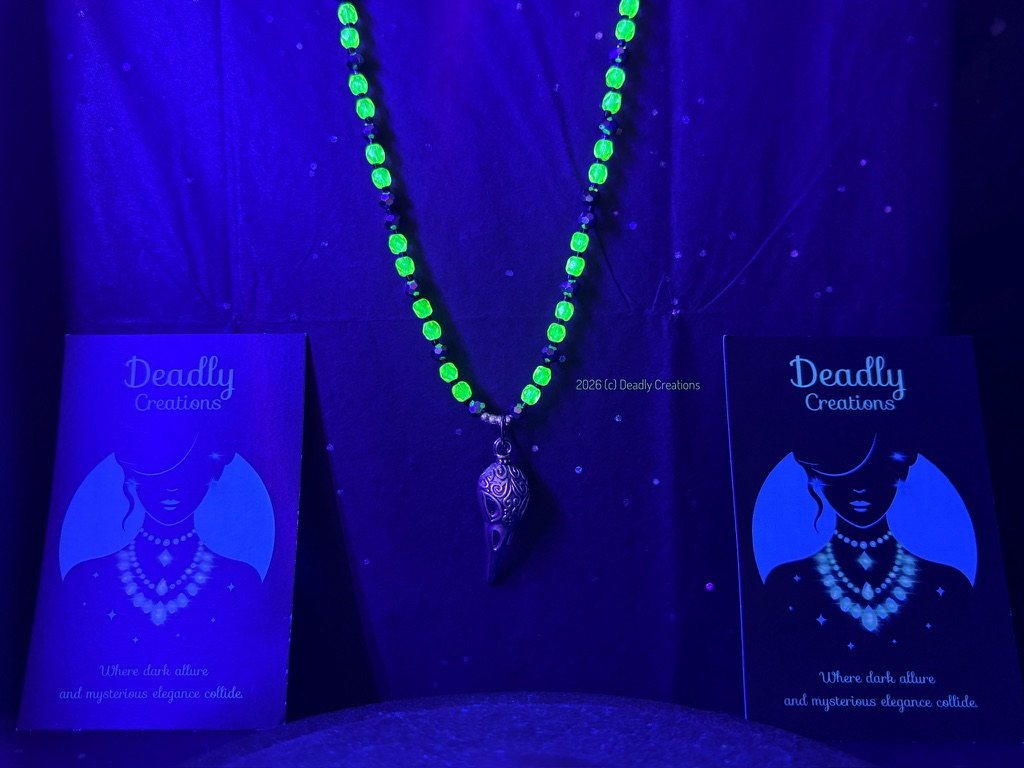
Author: Deadly Creations

  • The โ€œCamaliaโ€ Unicorn

    The โ€œCamaliaโ€ Unicorn

    Every collector has a ghost story. This is the most famous one.

    Henry Greenerโ€™s works in Sunderland pressed some of the brightest uranium glass in England. Standard pieces carried a whisper of uranium, one tenth of a percent to two percent. Just enough for a soft green glow.

    But the records hold a recipe called Camalia. Seven percent uranium. Far beyond anything else in the book, and it would have glowed like something alive.

    No piece of Camalia has ever been found. No shard. No photograph. Just the recipe, and the story.

    Either it was never made, or every piece vanished. Somewhere, maybe, a cabinet holds a glass that glows like a green sun, waiting for someone to shine a blacklight on it.

    Collectors call an impossible find a unicorn. Have you ever chased one?

  • The Resource Conflict

    The Resource Conflict

    The glow did not fade. It was confiscated.

    By the 1940s, uranium glass sat on ordinary shelves. Kitchenware. Vases. Trinket trays, glowing softly green. Then the war came, and the governments came for the uranium.

    In the US, every supply was seized for the Manhattan Project. In Britain, large quantities were confiscated too. Not because the glass was dangerous. Because the element inside it had a new purpose.

    The era of the glow ended abruptly, mid-factory. The furnaces went quiet, and some never lit again.

    After the war, a few glasshouses tried again, quietly. But the age of uranium glass, bright and careless and everywhere, was over.

    When you hold a piece of uranium glass, you are holding what the war reached for. Does that change how it feels?

  • Scientific Standardisation

    Scientific Standardisation

    Some glass has a fingerprint, and scientists can read it. 🕯️

    In the 1930s, James A. Jobling and his glassworks in Gateshead, England, took uranium mixing seriously. Routine chemical analysis. Trial melt after trial melt. All so his Jadeite range would glow with a perfectly consistent green.

    The result was a recipe so precise it left a chemical fingerprint. Every batch carried its own ratio of uranium to lead, a signature baked into the glass.

    Today, scientists can identify a fragment of Jobling glass the way detectives match a fingerprint. Uranium to lead ratios, read like a confession.

    A factory recipe for the perfect glow became a forensic tool. And when the war came, uranium was called away to darker work, and the recipe was never used again.

    Your glass can tell you who made it. Have you ever asked yours?

  • The Glass Before Time

    The Glass Before Time

    Before uranium had a name, someone was already using it. 🕯️

    In a Roman villa at Cape Posillipo, on the Bay of Naples, a mosaic was laid down in 79 AD. The same year Vesuvius buried Pompeii. Its yellow glass held one percent uranium oxide.

    One percent. Enough to colour it, long before anyone knew what uranium was.

    The word did not exist. Uranium was only identified in 1789, by a German chemist named Klaproth. But the Romans had already pressed it into their floors, and there it stayed, a secret in plain sight, until 1912.

    This forbidden ingredient is older than the name for it. Somewhere in a museum, a piece of it still waits in the dark.

    How old did you think uranium glass was? 💚

  • Murano Glass

    Murano Glass

    In 1291 glassmakers were banished from Venice to Murano, where they guarded the secrets of their craft for centuries; they were so valuable, in fact, that they were not permitted to leave, and were held in such high regard that their daughters could marry nobility.

    And what did these glassmakers make?

    Some of the most celebrated glass the world has ever known; Millefiori. Sommerso. Filigrana.

    And sometimes, uranium glass.

    Yes. The island of Murano made rare pieces, shaped by hands that guarded their secrets for generations, and that wake up wondrously green under a blacklight.

    Two secrets, bound into one object.

    Collectors know. Now you know too.

    Have you ever held a piece of Murano glass and wondered what it knew?

  • Burmese Glass

    Burmese Glass

    The unique colour gradient of Burmese Glass is achieved through a single body of glass that contains both uranium oxide, which provides the yellow colouring, and a tincture of gold, which provides the pink colouring.

    In England, Thomas Webb & Sons licensed the formula and marketed their version under this name, often adding intricate enamelled decorations.

    Most Burmese Glass has a soft, matte texture resembling velvet. This surface is specifically valued for its ability to diffuse light.

  • Canary Glass v Vaseline Glass

    Canary Glass v Vaseline Glass

    Canary Glass was a commercial name used as early as the 19th century in England and France (verre canari) to describe the bright yellow glass produced by makers like Josef Riedel and English manufacturers.

    Vaseline Glass is a later nickname, popularized in the 1930s, because the glassโ€™s pale yellowish-green hue resembled Vaseline-brand petroleum jelly as it was formulated at that time.

    According to collectors, Vaseline Glass must be transparent or semi-transparent, whereas Canary Glass is more vivid or intense yellow.

  • Vaseline Glass

    Vaseline Glass

    The term โ€œVaseline Glassโ€ refers to a particular kind of uranium glass produced by tempering the glass at high temperatures, giving it a distinguished texture and appearance; a pale yellowish-green or translucent yellow hue that matches the color of the Vaseline-brand of petroleum jelly.

    The term โ€œVaseline Glassโ€ is most widely used in the United States to describe decorative uranium glass artifacts; however, in other regions like the United Kingdom and Australia, the term is used more broadly to describe any type of translucent glass.

  • Uranium Glass in the Home

    Uranium Glass in the Home

    Over the years uranium glass has been used to create many everyday items, with popularity peaking between the 1880s and 1920s.

    It was commonly fashioned into plates, bowls, tumblers, and serving dishes, with specific varieties like โ€œcustard glassโ€ (opaque pale yellow) and โ€œJadeiteโ€ used for mixing bowls and refrigerator dishes.

    Additionally, due to its striking and beautiful appearance under natural and UV light, uranium glass has been used to create vases, figurines, beads, and jewellery.

  • The Depression Glass Era

    The Depression Glass Era

    Uranium glass and uranium minerals from an exhibit at the Mint Museum, Jรกchymov.

    The Depression glass era is one of the most fascinating chapters in American design history.

    Running roughly from 1929 to 1939, it represents a time when manufacturers found a genius way to inject a little bit of color and joy into everyday households enduring the bleakest years of the Great Depression.

    These pale green pieces were made using tiny amounts of uranium oxide. If you hit them with a UV blacklight today, they glow a brilliant, neon green!